
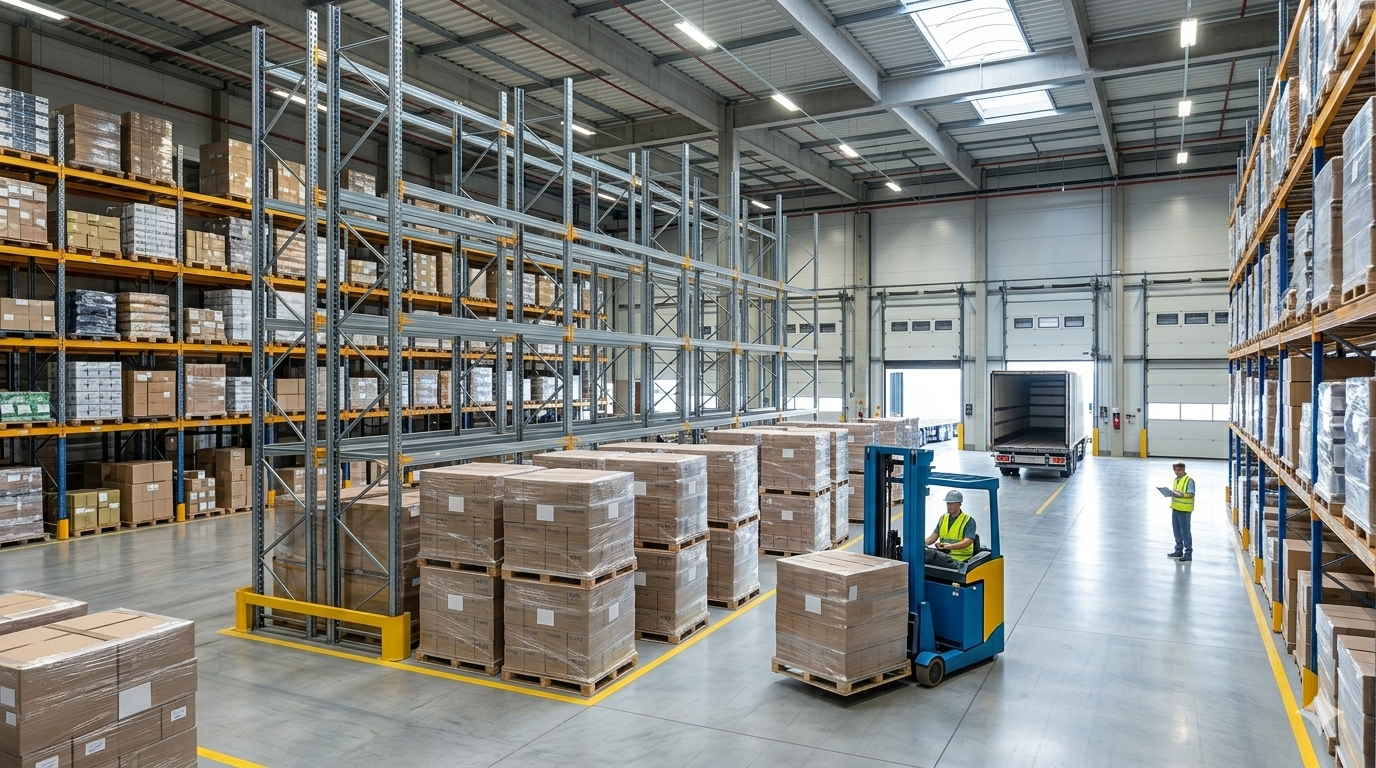
Moving a warehouse is not a bigger version of moving an office. An office move risks a few disrupted workdays. A warehouse move risks orders not shipping, inventory going uncounted, and racking sitting disassembled while product has nowhere to go. The cost of a slow or disorganized warehouse relocation is measured in missed shipments and lost inventory accuracy, not just labor hours.
This guide covers how a warehouse or distribution center relocation actually gets planned and executed: the phases, the systems that make it complex (racking, material handling equipment, inventory), and how to keep orders moving while the operation changes address. It is written for operations and logistics managers who own the outcome.
What makes a warehouse move different
Three things separate a warehouse relocation from a standard commercial move.
First, the building is a system, not just a container. Racking, mezzanines, conveyors, and dock equipment are installed infrastructure that has to be disassembled, transported, and reinstalled, not just carried out.
Second, inventory is money in motion. Every item moved is an asset that has to stay counted, undamaged, and findable in the new location. Lose track of it and the move creates an inventory write-off that dwarfs the moving bill.
Third, the operation usually cannot fully stop. Orders still need to ship during the transition. That forces a phased approach far more often than office moves, where a single weekend cutover is common.
The planning phases
A warehouse relocation runs in stages, and skipping the early ones is where most moves go wrong.
1. Site assessment, old and new
Survey both buildings before planning anything. Document dock count and height, clear ceiling height, column spacing, floor load capacity, power and data, and access for trucks and equipment. The new site’s constraints determine what racking and equipment can come with you and what has to change.
2. Inventory and asset planning
Decide what moves, what gets liquidated, and what is reordered after the move. A relocation is the natural moment to clear dead stock and obsolete equipment rather than pay to transport it. Tie this to a count, so inventory records match reality before anything leaves the building.
3. Racking and layout plan
Map the new layout before disassembly. Racking is reconfigured far more often than it is rebuilt identically, because the new building’s footprint and column grid rarely match the old one. Plan the slotting and pick paths for the new space, not the old one.
4. Move sequencing
Decide the order of operations: which zones move first, whether shipping continues from the old or new site during transition, and where interim storage fits if the two leases overlap or gap. This sequence is the spine of the whole project.
5. Schedule and downtime window
Set the realistic window for each phase, built around your shipping commitments. The schedule should protect order fulfillment first and move convenience second.
The systems that make it complex
Racking and storage systems
Pallet racking, shelving, mezzanines, and flow systems are engineered installations. They are disassembled, transported, and reinstalled, often reconfigured to fit the new floor plate. This is structural work that affects safety and load ratings, so it is reassembled to spec, not improvised.
Material handling equipment
Forklifts, reach trucks, pallet jacks, conveyors, and dock equipment have to be transported and recommissioned at the new site. Powered equipment needs to be ready on day one at the new location, because nothing moves on a warehouse floor without it.
Inventory accuracy and chain of custody
This is the part that quietly decides whether a move succeeds. Inventory should be tracked from the moment it leaves the old racking to the moment it is slotted in the new one, so counts stay accurate and nothing disappears in transit. Labeling, staging, and a clear handoff record keep the new-site inventory matching the system. A warehouse that reopens with inaccurate inventory has not finished moving, it has created a counting problem.
Dock and logistics scheduling
Trucks, dock doors, and staging space are finite. A warehouse move is partly a logistics problem in its own right: scheduling loads so the old dock empties in the right order and the new dock fills in slotting order, without trucks stacking up at either end.
Phased move vs. full shutdown
Two approaches, chosen by how much downtime your operation can absorb.
A phased move keeps orders shipping by relocating zone by zone, often running both sites briefly in parallel. It costs more in coordination and possibly overlapping rent, but it protects fulfillment. This is the default for operations that cannot go dark.
A full shutdown move concentrates the relocation into a closed window, usually when the business can tolerate a planned pause (a slow season, a holiday, a weekend for smaller operations). It is simpler and often cheaper, but only viable when you can afford to stop shipping.
Interim storage bridges the gap when leases do not line up or when a phased move needs product staged off-site. Short-term storage during transition keeps a move from being held hostage by a lease timing problem. You can see how staging and storage fit a move on our storage page.
A relocation readiness checklist
- Both sites surveyed: docks, ceiling height, floor load, power, truck access
- Inventory counted and reconciled before anything moves
- Dead stock and obsolete equipment identified for liquidation, not transport
- New-site racking layout, slotting, and pick paths planned
- Move sequence set around shipping commitments, not move convenience
- Material handling equipment transport and recommissioning scheduled
- Inventory tracking and labeling system in place for the transit
- Interim storage arranged if lease timing leaves a gap
- Dock and truck schedule mapped at both ends
Local considerations: Portland, Seattle, and Boise
Portland
Portland’s industrial corridors (the Columbia Corridor, Rivergate, and outlying areas toward Hillsboro and Gresham) mix older warehouses with newer distribution space. Older buildings often have lower clear heights and fewer docks, which affects what racking and equipment transfer cleanly to a new site. Truck access and dock scheduling matter more in tighter, older facilities.
Seattle
The Kent Valley and the broader Puget Sound industrial market carry higher rents and tighter availability, which makes lease timing and interim storage central to planning a Seattle warehouse move. Parallel-running two sites can be costly here, so sequencing to minimize overlap is worth the planning effort.
Boise
Boise’s growth has expanded industrial and distribution space across the Treasure Valley, including Meridian, Nampa, and Caldwell. Companies relocating here are often scaling into larger footprints, which makes the new-site racking and slotting plan, sized for where the operation is going rather than where it has been, the most important part of the move.
Frequently asked questions
How do you move a warehouse without stopping operations? By moving in phases. Relocate zone by zone and run both sites in parallel briefly so orders keep shipping, sequencing the work around your fulfillment commitments. Full-shutdown moves are simpler but only work when the operation can afford a planned pause.
What does a warehouse move include beyond boxes? Disassembling and reinstalling racking and storage systems, transporting and recommissioning material handling equipment like forklifts and conveyors, tracking inventory through the move, and coordinating docks and trucks at both sites. The infrastructure and inventory are the hard parts, not the product itself.
How long does a warehouse relocation take? It depends on size, inventory volume, racking complexity, and whether you move phased or in a single shutdown. The schedule should be built backward from your shipping commitments and the new-site readiness, not estimated as a flat number.
How do you keep inventory accurate during a move? Count and reconcile before anything leaves, then track and label inventory from old racking to new slotting so the system matches the floor on reopening. Accuracy is protected by the handoff process, not assumed.
Can racking be reused at the new building? Often, but it is usually reconfigured rather than rebuilt identically, because the new floor plate and column grid rarely match the old one. Reassembly is done to load-rating spec for safety.
The bottom line
A warehouse relocation is an inventory and infrastructure project that happens to involve trucks. Survey both sites, reconcile inventory before you move, plan the new-site racking and slotting deliberately, sequence the work around shipping, and keep product counted through the transit. Get those right and the move protects fulfillment instead of interrupting it.
If you are planning a warehouse or distribution center relocation in Portland, Seattle, or Boise, our team handles racking, equipment, and phased sequencing with interim storage when lease timing requires it. Start with equipment and industrial moves, and see how we support manufacturing and industrial operations.