
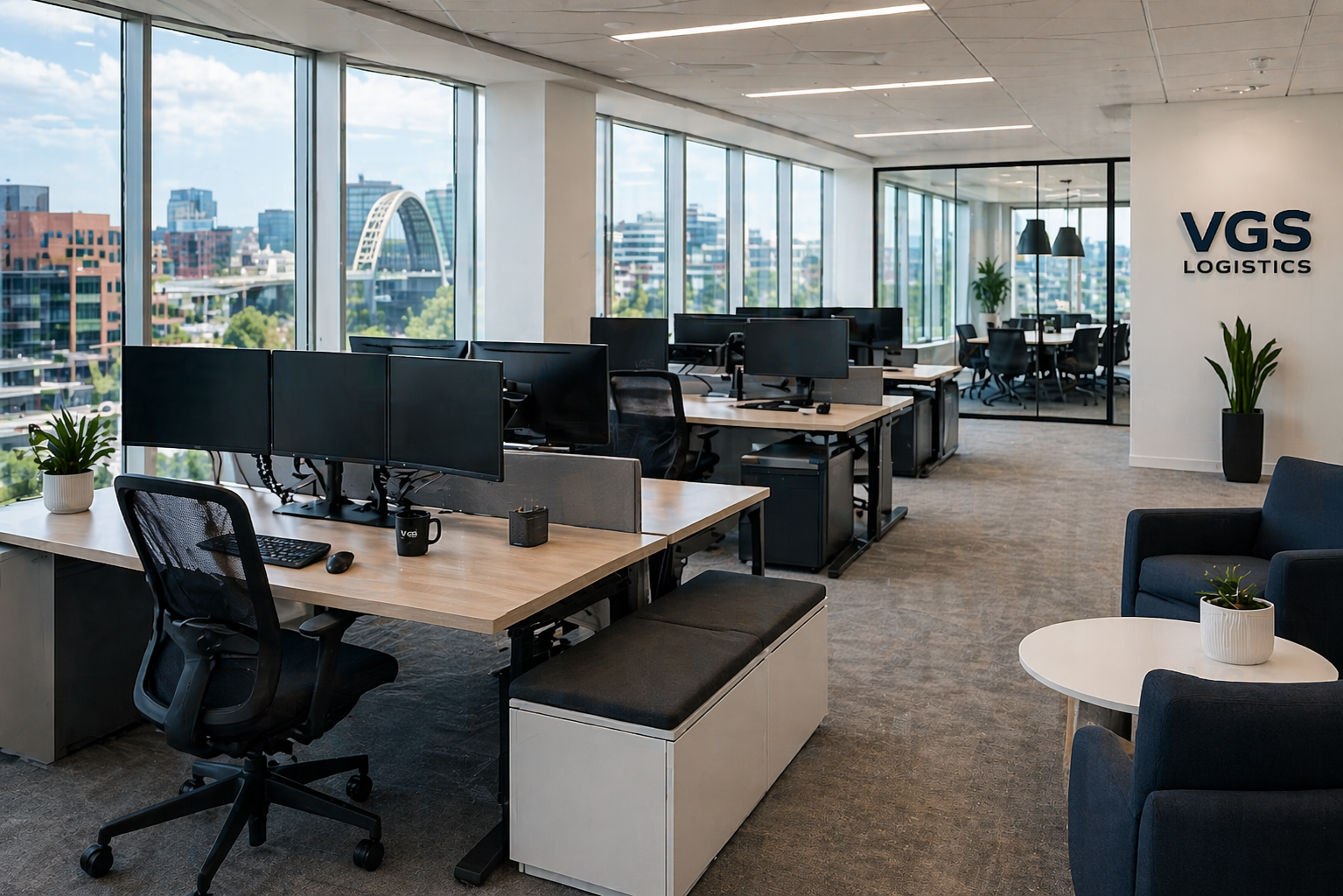
How to Plan a Smooth Office Relocation in Portland: A Step-by-Step Guide a successful Downtown Portland office relocation requires early planning, building coordination, and precise scheduling to avoid delays, minimize downtime, and keep your business fully operational during the transition.
If you’re preparing to move your office downtown, you already know this isn’t a simple task. You’re dealing with tight timelines, building rules, and the pressure to keep everything running without interruption. And in a dense area like Downtown Portland, even small missteps can snowball fast.
Buildings near Pioneer Courthouse Square often limit freight elevator access, restrict loading zones, and enforce strict move windows. Miss one of those pieces, and your entire schedule can shift. That’s the reality most generic moving advice ignores.
Downtown moves aren’t flexible. They’re coordinated. Property managers, engineers, vendors, and your internal teams all need to stay aligned. Even minor delays along corridors like Burnside Street or 5th and 6th Avenue can ripple across your entire move.
At its core, this isn’t just a move—it’s a business transition. When you treat it that way, everything changes. Done right, your team barely feels the disruption.
How to Plan a Downtown Portland Office Move (Step-by-Step Framework)
Planning a Downtown Portland office relocation starts 6–12 months in advance and follows a structured process: define scope, align stakeholders, secure building logistics, coordinate vendors, and execute in phases to reduce disruption.
Here’s the truth—checklists alone won’t carry you through a downtown move. You need a system. A framework that accounts for timing, dependencies, and real-world constraints.
Start with scope. How many people? What departments? What furniture systems and IT infrastructure are involved? Without clarity here, everything else becomes guesswork.
Next, build a timeline that actually reflects reality. Not your ideal schedule—your building’s schedule. In areas like the Pearl District, access windows book out quickly. Wait too long, and you’ll be forced into less desirable (and more expensive) time slots.
From there, align your stakeholders. Leadership, IT, facilities, and your relocation partner need to operate from the same plan. If one group lags, the entire move slows down.
Then lock in logistics early—freight elevators, loading zones, approvals. These aren’t small details. They dictate your entire execution window.
Finally, phase your move. Move teams in waves. Keep critical operations live while others transition. It’s not always possible—but when it is, it dramatically reduces disruption.
Bottom line? Your timeline isn’t built around convenience. It’s built around constraints. Accept that early, and your move becomes far more predictable.
Navigating Downtown Portland Logistics (Permits, Parking, Elevators)
Downtown Portland office relocations require coordination of permits, parking access, freight elevators, and traffic timing—without these secured, delays and added costs are almost guaranteed.
This is where most moves break down.
Freight elevators, for example, often need to be reserved weeks in advance. Miss that window, and you’re either rescheduling or squeezing into off-hours—neither of which is ideal.
Street-level logistics matter just as much. Securing a loading zone near your building—especially along high-traffic routes like Interstate 5 (I-5)—can make or break your efficiency. Without it, crews spend more time walking, staging, and waiting.
And then there’s everything else—parking limitations, pedestrian traffic, city regulations. Moving through the Lloyd District? You might be coordinating around large events or shared building schedules. That adds another layer of complexity.
Here’s a simple rule: confirm your elevator reservation and loading permit in writing. Those two items cause more delays than anything else.
Miss them, and everything slows down.
Office Relocation Services That Minimize Business Downtime
Minimizing downtime during a Downtown Portland office relocation requires more than moving labor—it demands coordinated move management, IT transition planning, and phased execution to keep critical operations running.
Most companies think hiring movers solves the problem. It doesn’t. Moving is just one piece of the puzzle.
What actually keeps your business running is coordination—what the industry calls move management. It’s the structured planning and sequencing of people, vendors, and tasks so nothing overlaps or falls through the cracks.
That includes:
- Workstation technology relocation (disconnecting and reconnecting systems)
- Furniture installation and reconfiguration
- Phased move execution to keep teams operational
Now here’s where location really comes into play.
Downtown Portland often forces moves into evenings or weekends due to building restrictions. Compare that to Beaverton, where daytime access is more flexible and logistics are simpler. Same size move—completely different execution strategy.
And here’s something most people underestimate: IT downtime costs more than the move itself. If your systems aren’t live, your business isn’t functioning.
That’s why sequencing matters. Get your infrastructure up early, not last.
Cost of a Downtown Portland Office Relocation (What to Expect)
The cost of a Downtown Portland office relocation is driven by access constraints, move complexity, building requirements, and downtime risk—making poor planning one of the most expensive variables.
At first glance, pricing seems straightforward—square footage, headcount, distance. But downtown changes that equation.
Logistics drive cost here.
Restricted elevator windows. Shared loading docks. Long carries from truck to office. These all increase labor time—and labor is one of your biggest cost drivers.
Timing matters too. After-hours and weekend moves often come with premiums. Sometimes they’re unavoidable.
Then there’s complexity. IT systems, modular furniture, specialized equipment—all require coordination and expertise.
Here’s where it gets interesting. A move in the Central Eastside might cost less than a similar move downtown—not because it’s smaller, but because it’s easier to execute.
And don’t overlook inefficiency. Delays, idle crews, extra trips—they all add up. Fast.
One hard truth: the cheapest quote often ends up costing the most. Why? Because it doesn’t account for what actually happens on move day.
The most cost-effective move is the one that runs smoothly.
The VGS Approach: How Downtown Portland Office Relocation Actually Works in the Real World
The biggest difference in a successful Downtown Portland office relocation isn’t the move itself—it’s how well every dependency is mapped, sequenced, and controlled before a single desk is touched.
Here’s what most companies miss.
Moves don’t fail because someone couldn’t carry a desk. They fail because timing breaks down between teams.
Furniture gets installed before IT is ready. Elevator windows close early. Vendors overlap or wait on each other. That’s where things go sideways.
At VGS, relocation is treated as a multi-phase system, not a one-day event.
- Pre-move alignment: everyone knows the plan
- Execution control: timing stays tight across teams
- Post-move optimization: everything works on day one
No gaps. No guesswork.
That’s how you keep operations moving.
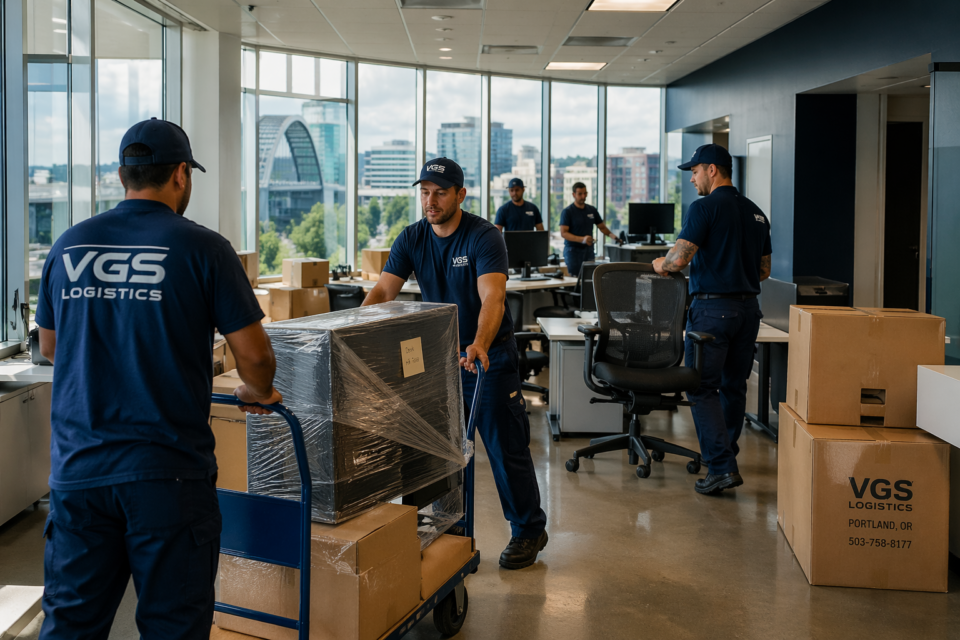
How Office Relocation Differs Across Downtown Portland (What Most Companies Miss)
Not all Downtown Portland office relocations are the same—each district brings its own challenges, and those differences directly impact cost, timing, and execution.
Take the Pearl District. You’ll often find older buildings with tighter freight access—but more flexible interiors. That makes reconfiguration easier, but scheduling becomes critical.
Near Pioneer Courthouse Square, things get tighter. More foot traffic. Shared loading zones. Strict timing windows. Moves here require precision.
The Lloyd District? Different story. Larger buildings, proximity to the Oregon Convention Center, and potential event-related congestion. Planning needs to account for variables you can’t always control.
Now compare that to Hillsboro. Open access. Fewer restrictions. Faster execution.
Same service. Completely different strategy.
That’s the nuance most companies overlook.
Conclusion: Turning a Complex Move Into a Controlled Transition
A Downtown Portland office relocation doesn’t have to feel chaotic. When you align planning, logistics, and execution, the entire process becomes controlled—predictable, even.
The difference comes down to precision. Understanding building constraints. Sequencing teams correctly. Anticipating challenges before they happen. That’s what keeps downtime low and costs in check.
If there’s one thing to take away, it’s this: treat your move like a system, not an event. When you do, everything runs smoother.
Start early. Get aligned. Lock in logistics. And most importantly—plan for how things actually work downtown, not how you wish they would.
Do that, and your move won’t just be successful—it’ll feel seamless.
Request a Quote Today