
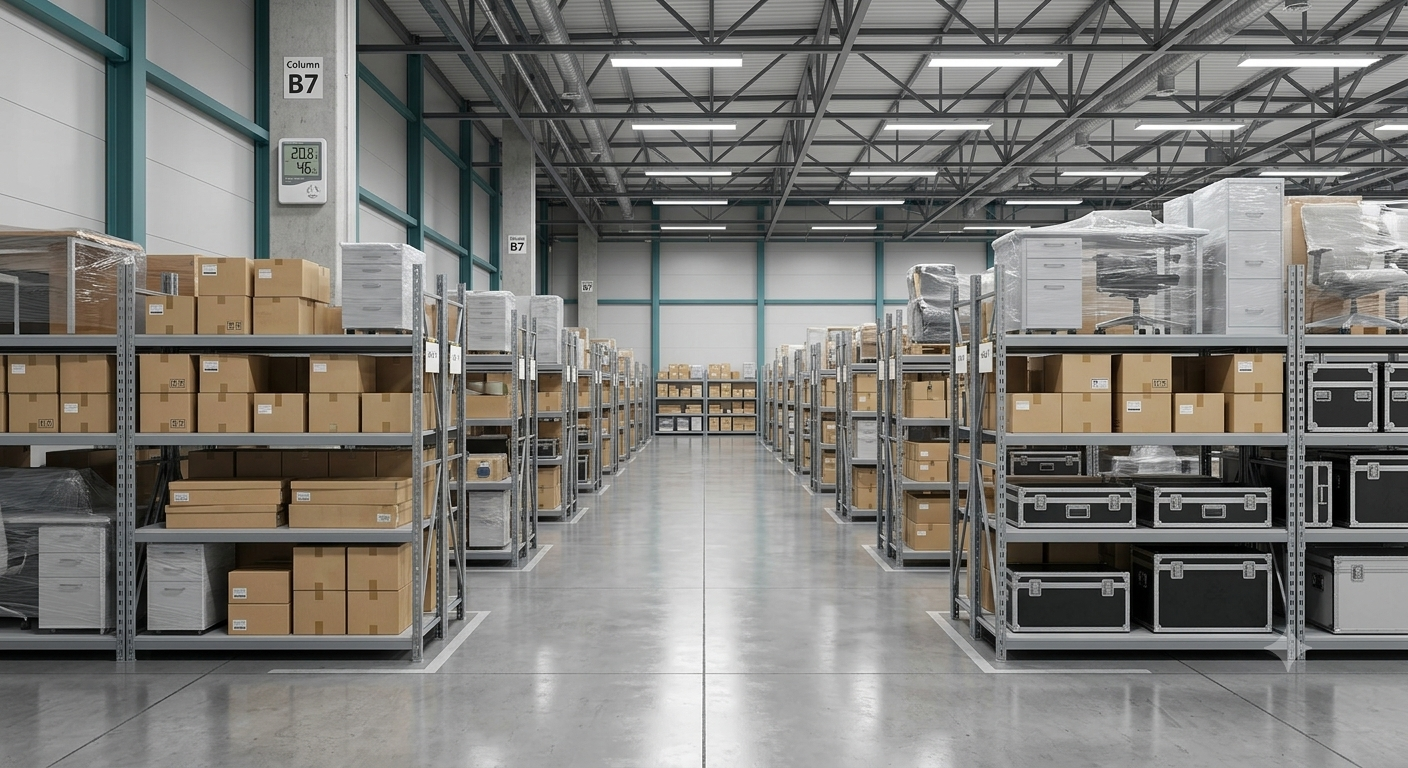
Storage gets added to a move budget as a single line item, priced as if every box and crate has the same requirements. They do not. Some assets are indifferent to temperature and humidity. Others are damaged by both, sometimes permanently, sometimes in ways that only show up months later when the item is unpacked and put back into use.
The cost difference between standard and climate-controlled storage is real, so it is worth knowing which assets actually need the upgrade and which do not.
What “climate-controlled” is actually protecting against
Two variables matter more than either alone: temperature swing and humidity. A space that holds a stable 68 degrees but swings between 30 percent and 70 percent relative humidity across seasons causes more damage to sensitive materials than a space that holds a stable 55 degrees with flat humidity.
Humidity swings cause materials to expand and contract. That is what warps wood veneer, delaminates laminate surfaces, and causes paper to cockle. Temperature swings are what condensation forms around, which is the more direct threat to anything electronic.
Standard storage controls neither variable. Climate-controlled storage controls both, though the range varies by facility, so if this matters for your assets, ask the vendor for the actual temperature and humidity range rather than assuming “climate-controlled” means one standard.
Assets that need it
Electronics and IT equipment. Servers, networking hardware, monitors, and anything with internal components are the clearest case. Condensation from a temperature swing can sit inside a chassis and cause corrosion or a short well after the equipment is powered back on, which makes the failure hard to trace back to the storage period.
Paper records and archival documents. Humidity is the primary threat. Paper absorbs moisture, expands, and becomes brittle as it dries out again. Documents under any retention or compliance requirement should not be stored in a space where humidity is not controlled, independent of how long the storage period is.
Wood veneer and laminate furniture. Real wood veneer expands and contracts with humidity in ways that particleboard core underneath cannot, which is what causes veneer to lift, crack, or separate. Laminate surfaces can delaminate under the same conditions.
Upholstered furniture. Fabric and foam absorb ambient moisture. In an uncontrolled space, that moisture creates conditions for mold and mildew, particularly in enclosed storage with limited air circulation.
Artwork, signage, and printed materials. Anything with ink, adhesive, or a printed finish is vulnerable to both heat and humidity in ways that are often invisible until the item is unpacked.
Specialty and lab-adjacent equipment. Instruments with calibration tolerances or sensitive internal components should be treated the same as IT equipment, and in some cases the manufacturer’s own storage specification will state a required range directly.
Assets that generally do not need it
Standard metal filing cabinets and shelving. Bare metal is largely indifferent to typical indoor temperature and humidity swings over a storage period measured in weeks or months.
Solid wood furniture without veneer. Still preferable to store in a stable environment, but far less vulnerable than veneer construction, since there is no adhesive bond layer to fail.
Non-sensitive equipment. Tools, fixtures, and hardware without electronic components or fine tolerances generally tolerate standard storage without issue.
Packing materials, crates, and moving equipment. No storage requirement beyond a dry space.
Finding what you stored, months later
Sorting assets correctly at intake solves half the problem. The other half is finding a specific item again once it is one of hundreds in storage, sometimes months or a full lease term later.
A facility that logs what went in, where it sits, and who has retrieval rights turns “we think it’s in unit 4” into a direct lookup. Without that, retrieval on a large storage job becomes a search.
Duration changes the calculation too
An asset that would be damaged by six months in an uncontrolled space may see no measurable effect from two weeks, because damage from humidity and temperature swings is cumulative and cyclical rather than immediate. A short bridge period between move-out and move-in is a different risk profile than a long-term hold, and the storage decision should be made against the actual duration, not a blanket policy for every asset type.
The exception is electronics. Condensation risk is tied to a single swing event, not to cumulative time, so a short storage window with an uncontrolled temperature change carries meaningfully more risk for electronics than the same window carries for furniture.
How storage security ties back to the same decision
Climate control protects assets from environmental damage. Security protects them from everything else, and the two are not interchangeable. A facility with excellent humidity control but no access restriction is not an appropriate home for records under a chain-of-custody requirement, independent of how well it handles temperature.
Look for continuous surveillance, restricted access rather than a shared unit, and fire suppression as a baseline, not an upgrade. For anything on the “needs climate control” list above, the same tier of facility should also meet the same tier of security. Splitting the two, climate-controlled but low-security, or high-security but uncontrolled, defeats the purpose for sensitive assets that need both.
Get a storage assessment before the move date, not after
Sorting assets into standard and climate-controlled storage is a decision made faster before the move than during it, when everything is already staged and the crew is waiting on an answer.
VGS Logistics storage combines climate control for sensitive items with 24/7 surveillance, restricted access, fire suppression, and detailed inventory tracking, available on short- or long-term plans alongside the office move itself for jobs that need both handled on one schedule.
Tell us what you are storing and for how long, and we will tell you which of it actually needs the upgrade.
Request a quote or call 503.878.5102.