
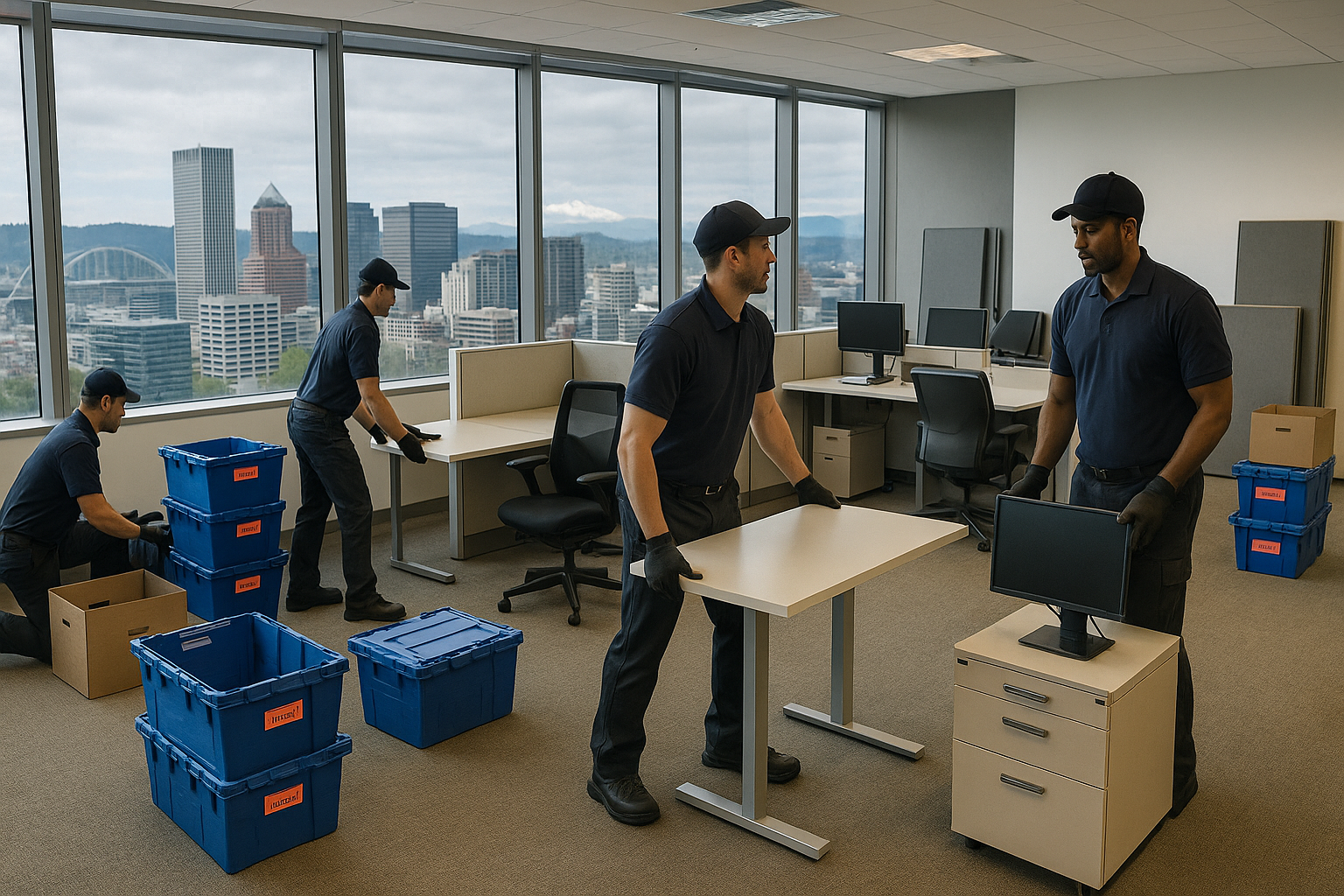
Commercial moves in Portland rarely fall apart on move day. More often, trouble begins weeks earlier—when a freight elevator window is misread, IT shutdown sequencing is rushed, or a furniture system isn’t mapped correctly. Anyone searching for portland commercial movers is usually looking for more than trucks and labor. They want clarity, predictability, and a partner who understands how commercial relocations actually work in this city.
It’s easy to feel overwhelmed while comparing options. Many companies offer similar service lists, yet few explain what truly determines whether a move goes smoothly. And because small planning gaps tend to create big downstream problems, uncertainty often builds fast. Research from groups like IFMA and CoreNet Global supports what many facility leaders already know: coordination, not muscle, decides the outcome.
This guide lays out the realities of commercial moving in Portland—office transitions, industrial relocations, FF&E and furniture systems, IT handling, decommissioning, and multi-phase projects. It brings together practical explanations, advanced frameworks, and Portland‑specific considerations that shape timelines and budgets.
By the end, you’ll know what matters most, how to evaluate your options, and what a well‑managed relocation actually looks like. You’ll also see how to avoid common pitfalls long before they appear.
What a Commercial Move in Portland Really Involves
A commercial move in Portland revolves around three core drivers: planning, sequencing, and building logistics. At its simplest, a commercial relocation means preparing your entire workspace—furniture, equipment, technology, and teams—to shift from one functioning environment to another with minimal downtime.
But Portland buildings introduce nuances that catch many organizations off guard. Some high‑rises restrict freight elevator access to narrow windows. Several Pearl District properties have no true loading dock. Many buildings require tightly worded COIs before any work begins. These factors often matter more than the move itself. Research from IFMA notes that small coordination gaps—missed elevator reservations, incomplete documentation, unclear vendor timing—are frequent sources of delay.
A successful commercial move generally includes:
- A detailed pre‑move inventory of FF&E, IT assets, and specialized equipment.
- A labeling system tied to a floor plan.
- Building‑specific logistics such as elevator timing, dock scheduling, and after‑hours requirements.
- Risk controls for IT handling, sensitive documents, and heavy equipment.
Why this matters: every piece of the process influences downtime. A mislabeled workstation slows a department for hours. A missed building requirement stalls everything. Understanding these core elements sets expectations and helps you evaluate potential partners.
Core Components of a Successful Office or Industrial Relocation
Every commercial move includes packing, transport, and setup. But when you look closer at an actual office or industrial relocation, these steps expand into a technical workflow.
- Packing and Preparation
Experienced teams use graded crates, anti‑static materials for technology, and color‑coded labeling tied to the floor plan. Facility‑management research from organizations like IFMA and CoreNet Global shows that preparation drives schedule reliability more than any other factor. - Equipment and Technology Handling
Servers, lab devices, and industrial machinery require specialized disconnection procedures. Sensitive IT assets benefit from serialized tracking to maintain visibility during each phase. - FF&E Disassembly and Reinstallation
Systems furniture from Herman Miller, Steelcase, and similar manufacturers uses torque‑specific fasteners and routing patterns. Incorrect assembly can cause alignment issues or warranty concerns. Manufacturer documentation, such as Herman Miller’s assembly instructions, shows how precise these installations are. - Transport Logistics
Lift‑gate trucks, dock‑height loading, and scheduled elevator access shape move sequencing. Some older Portland buildings limit truck clearance or vehicle size—details that influence staffing and timing. - Verification and Setup
When assets arrive onsite, teams verify workstation numbering, test equipment, and confirm adjacency requirements.
Overall, these steps determine how quickly business operations resume.
The 6‑Phase VGS Commercial Relocation Framework
Instead of treating a relocation as a list of tasks, this framework organizes the process into a predictable structure. It reduces risk, clarifies ownership, and supports multi‑phase projects.
Phase 1 – Discovery and Inventory
Teams document FF&E counts, IT assets, building constraints, and departmental needs.
Phase 2 – Planning and Vendor Coordination
Internal departments, building management, IT, low‑voltage vendors, and installers align schedules and responsibilities. Research from organizations like IFMA shows that coordination gaps are a leading cause of delays.
Phase 3 – Pre‑Move Preparation
Labeling, elevator reservations, packing instructions, and chain‑of‑custody protocols are finalized.
Phase 4 – Move Execution
Teams follow a structured sequence that includes IT shutdown, FF&E disassembly, department transitions, and loading.
Phase 5 – Setup and Testing
Furniture systems are reinstalled, equipment powered up, and departments walk their new spaces.
Phase 6 – Decommissioning and Closeout
Old spaces are cleared, assets recycled or liquidated, and lease‑return requirements documented.
Why this matters: a reliable structure minimizes surprises and ensures the project moves forward methodically.
Advanced Planning for Portland’s Most Challenging Building Conditions
Commercial moves often hinge on the building rather than the moving crew. Portland properties—especially older industrial sites and downtown towers—come with real constraints.
Freight elevators, for example, may only allow 3,500–4,500 lbs at a time. Some buildings share elevators among tenants, forcing precise sequencing. Research bodies such as BOMA emphasize how access limitations can influence project timelines.
Dock access can be just as limiting. Pearl District sites often require curbside staging or spotters. Older industrial buildings may restrict truck length or turning radius.
And after‑hours requirements add cost. Several Class A properties mandate nighttime moves, which can affect staffing and HVAC or security fees.
These constraints shape everything from schedule forecasts to cost structures.
FF&E Logistics, Furniture Systems and Decommissioning
Systems furniture is engineered equipment—not generic office furniture. Herman Miller, Steelcase, and similar manufacturers publish detailed instructions specifying torque values, routing requirements, and assembly sequences. Examples appear in documentation like Herman Miller’s assembly resources.
Decommissioning is often misunderstood. Many assume it’s purely a cost, yet responsible furniture resale, donation, and recycling can reduce expenses. Analyses based on EPA data, such as this overview, note that furniture waste historically contributes significantly to landfill volume.
Sequencing matters too. Furniture installation affects IT deployment, adjacency planning, and workstation readiness.
Technology and Sensitive Equipment Relocation
Technology relocation is far more involved than unplugging and reconnecting devices. Standards from organizations like NIST outline physical and environmental controls that help safeguard IT assets during transitions.
Servers often require controlled shutdowns and anti‑static handling. Lab equipment may need certified vendor disconnection. And some devices shouldn’t sit in unconditioned trucks.
Tracking matters as well. Chain‑of‑custody concepts, reflected in resources from groups such as CISA, support accountability for sensitive equipment.
The Operational Continuity Matrix
This model evaluates assets by operational criticality and transition complexity. It helps organizations focus on what truly matters.
Quadrant examples:
- High criticality / high complexity: servers, specialized equipment.
- High criticality / low complexity: executive or financial teams.
- Low criticality / high complexity: modular systems requiring certified installers.
- Low criticality / low complexity: general office contents.
This framework guides attention toward the elements that carry the highest operational risk.
The Hidden Cost Curve of Commercial Moves
Commercial moves tend to follow three cost categories:
Visible costs: trucks, labor, materials.
Latent costs: rescheduled vendors, after‑hours building fees, extended installations. These often exceed the visible ones.
Opportunity costs: productivity lost when technology isn’t online or teams aren’t operational.
Recognizing all three helps organizations create realistic budgets and plan around risk.
The Future of Commercial Moving in Portland
Several trends are shaping future relocations:
- Building access controls are becoming tighter.
- Sustainability goals are driving landfill diversion; analyses of EPA data, such as this summary, highlight growing expectations for responsible disposal.
- Technology planning is becoming the first—not last—step.
- Digital inventory and move‑management tools are emerging.
Organizations benefit from preparing for these shifts early.
Conclusion: A Clear Path Forward
When you look across the full process, the goal isn’t just to move assets—it’s to maintain continuity. Everything described in this guide, from FF&E to technology, sequencing, and decommissioning, supports that single objective. These principles reflect what consistently helps commercial relocations stay on schedule and minimize downtime.
If you’re preparing for an office or industrial move, a few steps can help: confirm building rules early, identify high‑criticality equipment, and align IT and furniture timelines long before move day. While some factors are inherently complex, knowing them upfront makes planning far easier.
The intent here isn’t for you to become a relocation specialist, but to understand what a well‑structured process looks like. If questions come up or unique constraints apply to your project, reaching out for guidance can help clarify your path forward.