
Most office moves default to cardboard because it is what people picture when they think of moving. For a commercial move in Portland, that default is usually the wrong one. Reusable plastic moving crates change the math on speed, labor, and downtime in ways that matter far more for a 60-person office than for a household.
This guide compares reusable crates against cardboard boxes for office moves specifically, on the factors that actually affect your move day: how fast teams pack and unpack, how well contents survive, how much labor and downtime each creates, and what each truly costs once you count everything. It is written for the office or facilities manager planning the move, not buying tape.
What reusable office moving crates are
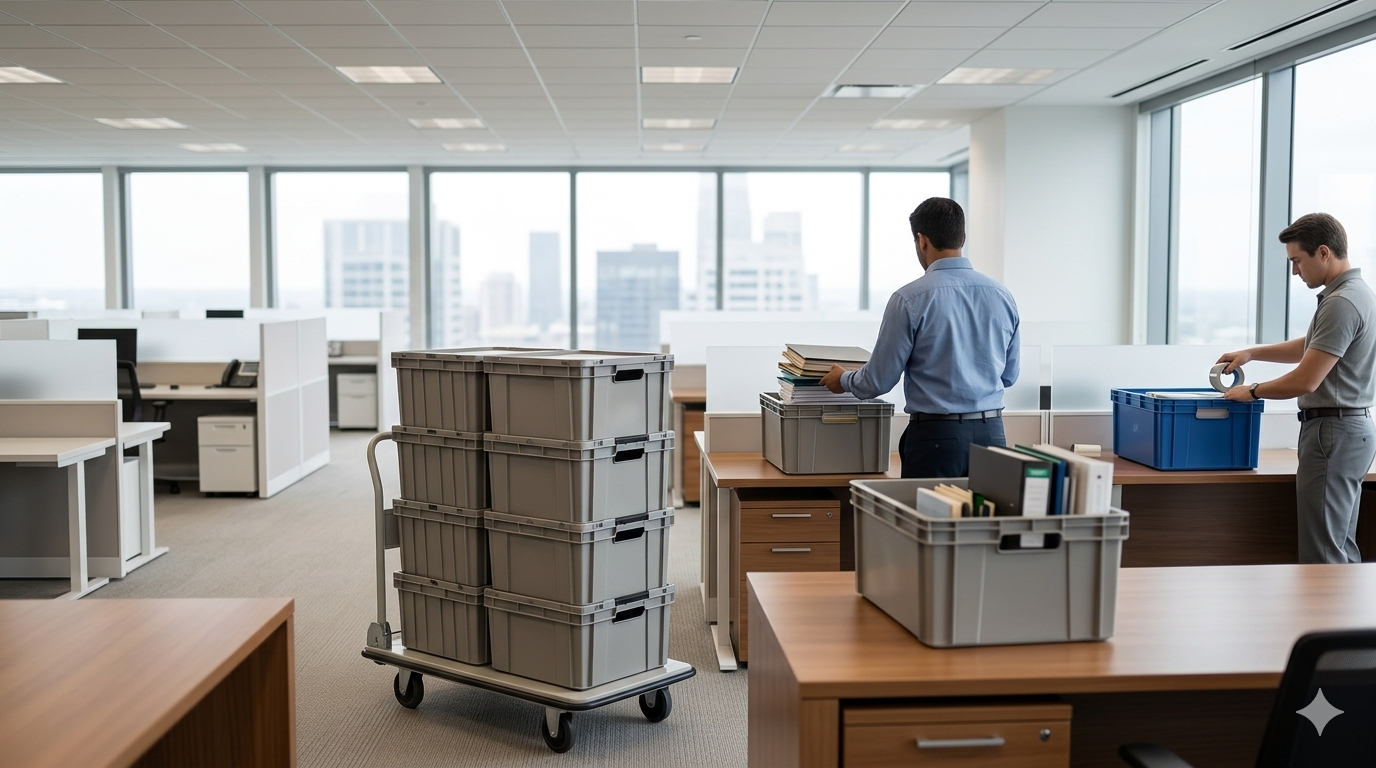
Reusable moving crates are stackable plastic containers, usually rented for the duration of a move, with attached or fitted lids and a uniform size that fits standard moving dollies and carts. They are delivered before the move and picked up after, so you are renting capacity for a window rather than buying and disposing of packaging.
Specialty versions exist for the things offices move most: crates sized for hanging files, padded or slotted crates for monitors and IT, and roll-top or secured crates for sensitive materials. That specialization is the reason crates outperform boxes for office contents specifically.
The real comparison
Speed of packing and unpacking
This is the biggest difference and the one that drives everything else. Crates require no assembly and no tape. A team opens a lid, fills it, closes it, and stacks it. On the other end, they open the lid and empty it. Cardboard has to be built, taped, labeled, taped again, and then broken down and disposed of after. Across an office, that taping and assembly time adds up to real hours and a slower return to work.
Protection and stacking
Rigid plastic protects contents better than cardboard, which crushes, sags, and gives way under weight or in humidity. Crates stack squarely and lock together, so loads are stable on carts and in trucks. For monitors, files, and IT gear, the rigid sides and consistent shape mean less shifting and less damage in transit.
Labor and downtime
Because crates load onto dollies and carts in uniform stacks, they move in fewer trips with less handling. Combined with no assembly or breakdown time, that means a faster move and a faster reopening. For an office, the cost that matters is not the packaging, it is how many work hours the move consumes and how long teams are unproductive. Crates compress both.
Security and chain of custody
Lids and zip-tie or seal options let you close and secure a crate, which matters for confidential files, HR records, or sensitive equipment. Sealed, labeled crates support a clean chain of custody from old desk to new desk, something an open cardboard box does not offer.
Sustainability and waste
A cardboard office move ends with a mountain of flattened boxes and tape headed for recycling or the dumpster. Reusable crates are used hundreds of times and hauled away after the move, so they generate almost no move-day waste. For Portland organizations with sustainability commitments or ESG and green-building reporting, that waste reduction is a documentable benefit, not just a feel-good one.
Cleanliness and order
Uniform crates with lids keep a move organized and contained. Labeling is consistent, stacks are tidy, and the new space does not fill with mismatched, half-collapsed boxes. That order is part of why crated moves reopen faster.
Cost, counted honestly
Cardboard looks cheaper per unit, and for a tiny move it is. For an office move, compare the total: crate rental for the move window versus buying boxes, tape, and labels, plus the labor to assemble and break them down, plus disposal. Once labor and downtime are in the math, the gap narrows and often reverses for commercial-scale moves. The right comparison is total cost of the move, not the price of one container.
Reusable crates vs. cardboard, at a glance
| Factor | Reusable crates | Cardboard boxes |
|---|---|---|
| Pack/unpack speed | Fast, no tape or assembly | Slow, build, tape, break down |
| Protection | Rigid, crush-resistant | Crushes, sags, weak in humidity |
| Stacking | Uniform, locks, stable | Uneven, shifts |
| Security | Lids, seals, chain of custody | Open, unsecured |
| Move-day waste | Minimal, hauled away | High, recycling or disposal |
| Best for | Office and commercial moves | Very small moves, odd items, long-term storage |
| Cost basis | Rental for the window | Purchase plus tape, labor, disposal |
When cardboard still makes sense
Crates are not always the answer. Cardboard is reasonable for a very small move, for oddly shaped items that do not fit a uniform crate, and for things going into long-term storage where you are not returning a rental. Many office moves use mostly crates with a small amount of cardboard for the exceptions.
How crate rental works for an office move
A crated office move runs on a simple cycle. Crates are delivered ahead of the move in a quantity scaled to your headcount and contents, along with the carts to move them. Teams pack in the days before, the crates move on move day, teams unpack at the new space, and the empties are collected afterward. Specialty crates for files, monitors, and IT are mixed in as needed. The planning task is estimating quantity and rental window so you have enough crates for the period without paying for idle ones, which is something your mover sizes with you based on station count and content type. You can see how this fits into a move on our crate systems page, and how it ties into full move management.
Portland specifics
Portland’s older downtown and Pearl District buildings often have tight freight elevators, narrow corridors, and building-managed loading windows. Uniform, cart-mounted crates move through those constraints faster and in fewer trips than loose cardboard, which matters when your loading window is fixed and the elevator is shared. The flip side is that crate quantities and cart logistics have to be planned around those access limits, not improvised on the day.
Portland’s strong sustainability culture is a second reason crates fit the market. Organizations tracking waste diversion or pursuing green-building goals can count the avoided cardboard as a measurable reduction, and a crated move aligns with the low-waste expectations many Portland tenants and building owners already hold.
A crate planning checklist
- Estimate crate quantity by station count and content type, not a flat guess
- Set the rental window to cover pack, move, and unpack without idle days
- Add specialty crates for files, monitors, and IT
- Plan labeling so crates map to destinations in the new space
- Confirm cart counts and freight-elevator access for the move window
- Identify the few items that genuinely need cardboard or custom packing
- Schedule empty-crate pickup so they do not clog the new space
Frequently asked questions
Are reusable moving crates better than cardboard boxes for an office move? For commercial-scale moves, usually yes. Crates pack and unpack faster with no tape or assembly, protect contents better, stack securely, and create almost no waste. Cardboard still suits very small moves, odd-shaped items, and long-term storage.
How many moving crates does an office need? It scales with headcount and what each person and department stores. Quantity is estimated by station count and content type rather than a single number, and your mover sizes it with you so you rent enough for the window without paying for idle crates.
How much do office moving crates cost to rent? Crates are typically rented per crate for the move window. The figure that matters is total move cost: rental compared against buying boxes, tape, and labels, plus the labor to assemble and break them down and the cost to dispose of them. At office scale, the total often favors crates.
Do moving crates come with lids and can they be secured? Yes. Office moving crates use lids and can be sealed with zip ties or tags, which supports a chain of custody for confidential files and sensitive equipment that an open box cannot.
How long can we keep the crates? For the rental window you arrange, normally covering packing before the move and unpacking after. Setting that window to match your schedule avoids both running short and paying for idle days.
The bottom line
For a Portland office move, reusable crates beat cardboard on the things that decide a commercial move: packing and unpacking speed, protection, secure handling, and almost zero waste, with a total cost that favors crates once labor and downtime are counted. Keep a little cardboard for the exceptions, plan crate quantity and access around your building, and the move runs faster and cleaner.
If you are planning an office move in Portland and want to compare a crated move against cardboard for your headcount and building, our team sizes the crate quantity, specialty crates, and rental window with you. Start with crate systems and office moving crates.