
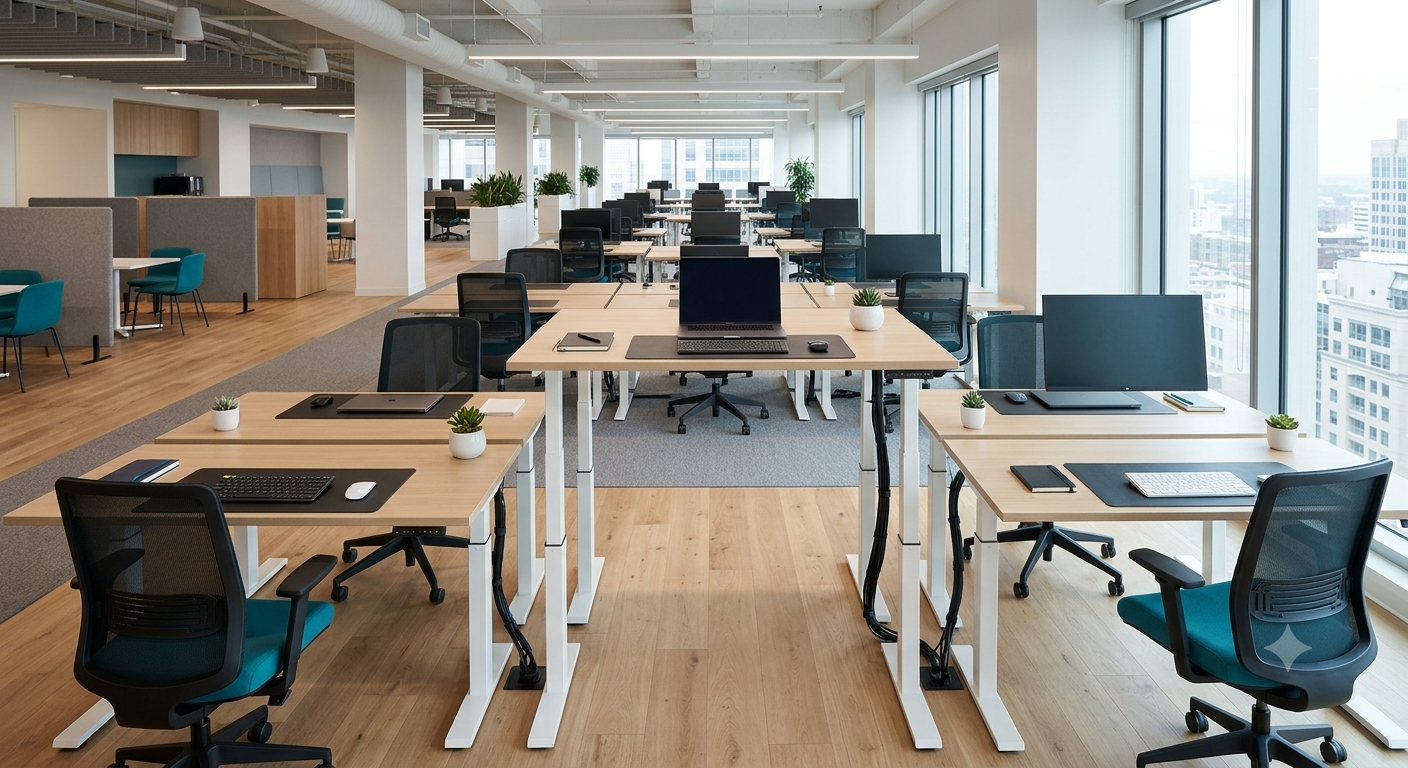
A single adjustable height desk is a furniture purchase. Fifty of them, going into one floor on one weekend, is a deployment project with its own sequencing, power planning, and failure points, most of which have nothing to do with which desk you chose.
This is what changes once the number of desks goes from one to many.
Base selection is a load decision, not a style decision
Electric sit-stand bases come in two-leg and three-leg configurations, and the difference is not cosmetic. A two-leg base is rated for less weight than a three-leg base of the same tier, because the third leg adds a stability point under load. Across a deployment where every station has the same equipment, that difference is easy to standardize on. Across a deployment where roles vary, it is not.
A single monitor and a laptop dock is a light load. Dual monitors, a docking station, and a desktop tower is not. Sizing every station to the lightest load in the building under-specifies the heaviest ones, and sizing every station to the heaviest load over-spends on the lightest ones. The right approach for a multi-department rollout is a load audit by role before the order is placed, not a single base tier applied to the whole floor.
Power is the constraint that decides your sequencing
Electric bases need power at the desk, which means every station in the deployment needs an accessible outlet, not just a nearby one. This sounds obvious until the floor plan and the electrical plan disagree, which happens more often in older buildings and in spaces that were previously configured for fixed-height desks with power run to a different point.
Two things to confirm before a deployment date is set, not during it:
Outlet location relative to final desk position. A floor plan drawn before furniture placement often shows power at the wall, not at the workstation. If cable runs need to cross an aisle or a walkway, that is a facilities conversation that has to happen before install day, because it usually is not a same-day fix.
Circuit capacity for the total load. A single desk drawing power for a base motor is negligible. Fifty of them on the same circuit, cycling simultaneously during a first-day height adjustment as everyone tries their new desk, is not the same math.
Cable routing at scale is a labeling problem before it is a physical problem
A single desk with a tangle of cables is an annoyance. Fifty desks with the same tangle, installed on the same day, is fifty separate troubleshooting calls in the first week, because a moving desk surface pulls on cables in a way a fixed desk never did.
Routing cable through the base’s cable management channel at install time, rather than after the fact, is the difference between a cable that moves with the desk and a cable that catches on it. This matters more for adjustable desks than fixed ones specifically because the working height changes daily, and any cable run that was fine at one height can go taut or slack at another.
Programming height presets during install, not after
Electric bases with memory settings let a user save a sitting and standing height so the desk returns to it with one button rather than a manual adjustment every time. Setting these presets is straightforward per desk and genuinely time-consuming across fifty, which is why it belongs in the installation sequence rather than left as a task for each employee on their first day.
Doing this at install time also catches base or motor issues while the installer is still on site, rather than after a call from a desk that will not hold its programmed height a week later.
Sequencing a floor-wide rollout
The install order that works for one desk does not scale directly to fifty. A sequence that holds up:
Confirm power and cable paths per station first, before a single base arrives. This is the step that gets skipped when a rollout is scheduled around a move date rather than around readiness, and it is the step that causes the most delay when it is skipped.
Assemble and test bases in a staging area, not directly at final position, so a defective unit is caught before it is wired into a workstation.
Install in zones, not by desk count. A department-by-department or floor-section sequence lets the rest of the office keep functioning while one zone is mid-install, rather than the whole floor being unusable at once.
Program height presets and verify cable routing as each zone completes, rather than batching all programming to the end. A zone that is fully done, tested, and usable is worth more than four zones that are all partially done.
What actually causes deployment delays
Almost never the desk itself. Nearly always one of three things: power that was not confirmed against final desk position, a load mix that was not audited by role before ordering, or an install sequence that tried to do the whole floor as one event instead of zones.
Plan the deployment before the desks arrive
A rollout that accounts for power, load, and sequencing before install day runs in hours. One that discovers those gaps on install day runs in days.
VGS Logistics deploys adjustable height desks at scale, with base selection matched to actual load, cable routing built into installation, and height presets programmed on site, alongside furniture installation for the rest of the floor.
Tell us your station count and equipment mix, and we will map the base tiers and install sequence before a single desk ships.
Request a quote or call 503.878.5102.