
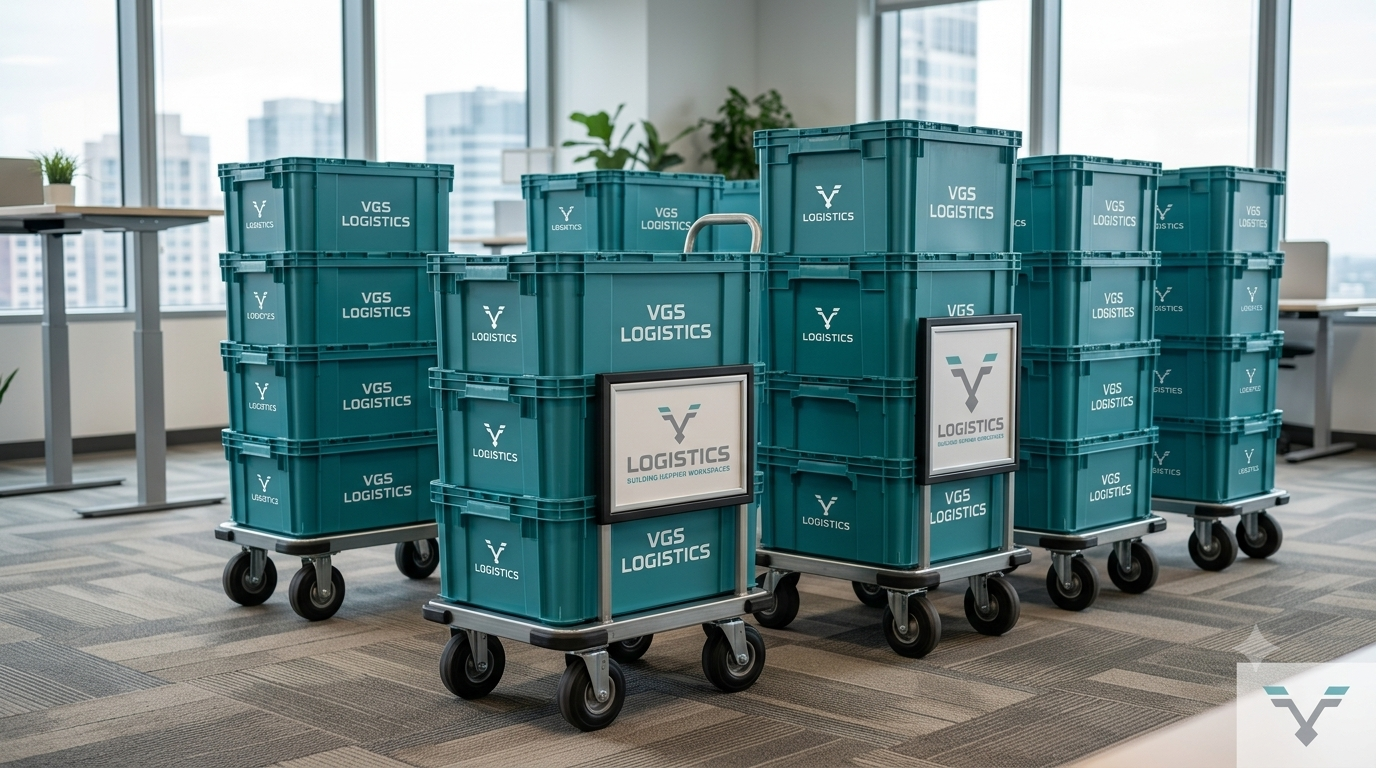
A crate rental is a scheduled asset, not a supply order. Crates arrive on a date, occupy floor space you are paying rent on, and have to be consolidated and returned on a date. That is why crate problems are almost never about the crates. They are about timing.
Most teams plan the packing. Far fewer plan the six stages around it. This is what the full cycle looks like and where it tends to break.
Stage 1: Delivery and drop placement
Crates arrive nested on dollies, usually through the same freight elevator and loading dock your move will use later. Two decisions get made before the truck arrives, and both are easy to get wrong.
Where the crates land. A single large drop point in a lobby or open area is the fastest unload for the delivery crew and the slowest distribution for everyone else. Staff then carry crates across the floor to their own desks, which is the part nobody budgeted time for. Distributed drops by floor, wing, or department cost more time on delivery day and save more time across the packing window.
When they land. Crates delivered too early sit in circulation space, block egress paths, and start accumulating rental days before anyone can use them. Crates delivered too late compress the packing window into evenings and weekends.
What building management needs to know first
Dock scheduling, elevator reservations, and floor protection requirements are set by the building, not by you or your mover. Confirm all three before you agree to a delivery date. A crate delivery that shows up without a reserved dock slot gets turned away, and the rental clock does not care.
Stage 2: Staging and distribution
Staging is the step between “the crates are in the building” and “the crates are where people will pack them.”
Good staging is organized by the same unit your move plan uses. If your move plan is sequenced by department, stage by department. If it is sequenced by floor and phase, stage by floor and phase. When staging logic does not match move plan logic, the mismatch surfaces on move day, when crates have to be re-sorted under time pressure.
Staging is also when allocation errors become visible, and they are usually errors of type rather than count. Headcount tells you how many standard crates a department needs. It tells you nothing about the crates that are not standard.
Workstations with docking stations, monitors, and peripherals need crates built for equipment rather than files. Departments running a records purge alongside the move need purge bins, not moving crates, because material being destroyed should never travel in the same container as material being relocated. Departments holding shared inventory, samples, or shop materials are under-allocated by any headcount formula.
Catching this at staging is recoverable. Catching it at 6pm on the last packing day is not.
Stage 3: Labeling
Labeling is where the crate cycle either works or quietly fails, because a crate with an unreadable destination becomes a crate that gets opened, inspected, and re-routed by hand at the new site.
A usable label carries three things:
- Destination, specific enough to act on without a floor plan. A room number, workstation ID, or zone code. Not a person’s name alone, because seating changes between planning and move day.
- Sequence, so unloading order matches the order the new space becomes usable. First-in crates should be the ones the destination floor needs first.
- Owner or department, for reconciliation. This is how you find the missing crate.
Why label placement matters as much as label content
Crates get stacked. A label on the top face is invisible in a stack of six. Labels belong on the end face that stays visible when crates are stacked and loaded, and the same face should be used across the whole job so unloading crews are not walking around every stack looking.
Stage 4: The packing window
The packing window is the number of days between distribution and load-out. It is the single largest driver of your rental duration, and it is usually set by the least available people in the building rather than by the move schedule.
Two things shorten it. First, packing instructions issued before crates arrive, so staff are not learning the system and using it in the same hour. Second, a hard cutoff communicated as a time, not a day. “Crates sealed and labeled by 3pm Thursday” produces a different result than “pack by Thursday.”
Two things lengthen it. Executives and specialty roles who pack last, and any department that discovers mid-window that it needs a different crate configuration than it was allocated.
Stage 5: Transport
Crates move on wheels, not in arms, and the equipment is not interchangeable. Carpeted dollies protect finished flooring on occupied floors. H-frame dollies handle taller stacks over longer runs. Hand trucks cover stairs and tight corners where a dolly cannot turn. Computer and inventory carts carry loads that should not be stacked at all.
Matching equipment to route and load is a planning decision, not a move-day one. A floor with carpet transitions, a long dock run, and a single freight elevator needs a different equipment mix than an open floor with a dock at the same level.
Stacking limits matter here too. Crates are rated for stacking, but a stack that is stable in a staging area is not necessarily stable rolling over a threshold plate or across a lobby transition strip. Load height gets set by the route, not by the crate spec.
Stage 6: Unpacking and the empty crate problem
This is the stage most plans skip entirely.
Once staff unpack, the empties have to go somewhere. If nowhere is designated, they go into circulation space, conference rooms, and hallways in the new office, in the exact week when the new office needs to look and function like an office. Empty crates in a new space are a facilities problem and a first-impression problem at the same time.
Designate empty return points on the floor plan before move day, in the same way you designate crate drop points at the origin. Then set an unpack deadline that is earlier than the pickup date, so the empties are consolidated and ready when the truck arrives instead of being hunted down while it waits.
Stage 7: Pickup
Pickup is a scheduled event with the same building requirements as delivery: dock slot, elevator, and access.
Two things turn a scheduled pickup into a problem. Crates that are not consolidated at the return points, which converts a single collection into a floor-by-floor sweep and burns the dock window. And crates that are still full, which cannot be collected at all and extend the rental for the entire job, not just the department holding them.
Count reconciliation happens here. The number that went out has to match the number that comes back. This is the reason the owner or department field on the label earns its place.
What actually determines your rental duration
Rental duration is not the length of your move. It is the span from the delivery date to the pickup date, which includes:
- Delivery and distribution time
- The full packing window
- Move day or move phases
- The unpacking period at the destination
- Empty consolidation before pickup
Teams routinely estimate the third item and forget the other four. When a crate rental runs longer than planned, the overrun is almost always sitting in the packing window or the unpacking period.
The failures worth designing against
Crates delivered before the space is ready to receive them. Rental days accrue while the crates are in the way.
Labels that name people instead of places. Seating assignments change after labels are printed.
No designated empty return points. The new office absorbs the storage problem.
Allocation by headcount alone. Headcount sets crate count. It does not set crate type, and type is where allocation actually fails.
Pickup scheduled to the same date as unpack completion. No buffer means the empties are not ready when the truck is.
Questions to ask before you sign
- What is the rental period, and when exactly does the clock start and stop?
- Who distributes crates to floors and departments, your team or the vendor?
- What crate types are available beyond the standard size, and how is the mix decided?
- What move equipment comes with the crates, and is it matched to the building and route?
- What happens if the packing window runs long?
- Does the vendor place labels, or supply them for your team to place?
Getting written answers to these six before the delivery date is what separates a crate rental that runs to plan from one that does not.
Plan your crate cycle before you set the move date
The crate schedule and the move schedule are the same schedule. When they are planned separately, the gap shows up as rental days you did not budget and a packing window that runs into a weekend.
VGS Logistics provides reusable crate systems in multiple sizes and configurations, with delivery, on-site staging, labels, and post-move pickup built into the office move plan rather than bolted onto it.
Tell us your target move date and floor count, and we will map the delivery, packing, and pickup windows around it.
Request a quote or call 503.878.5102.