
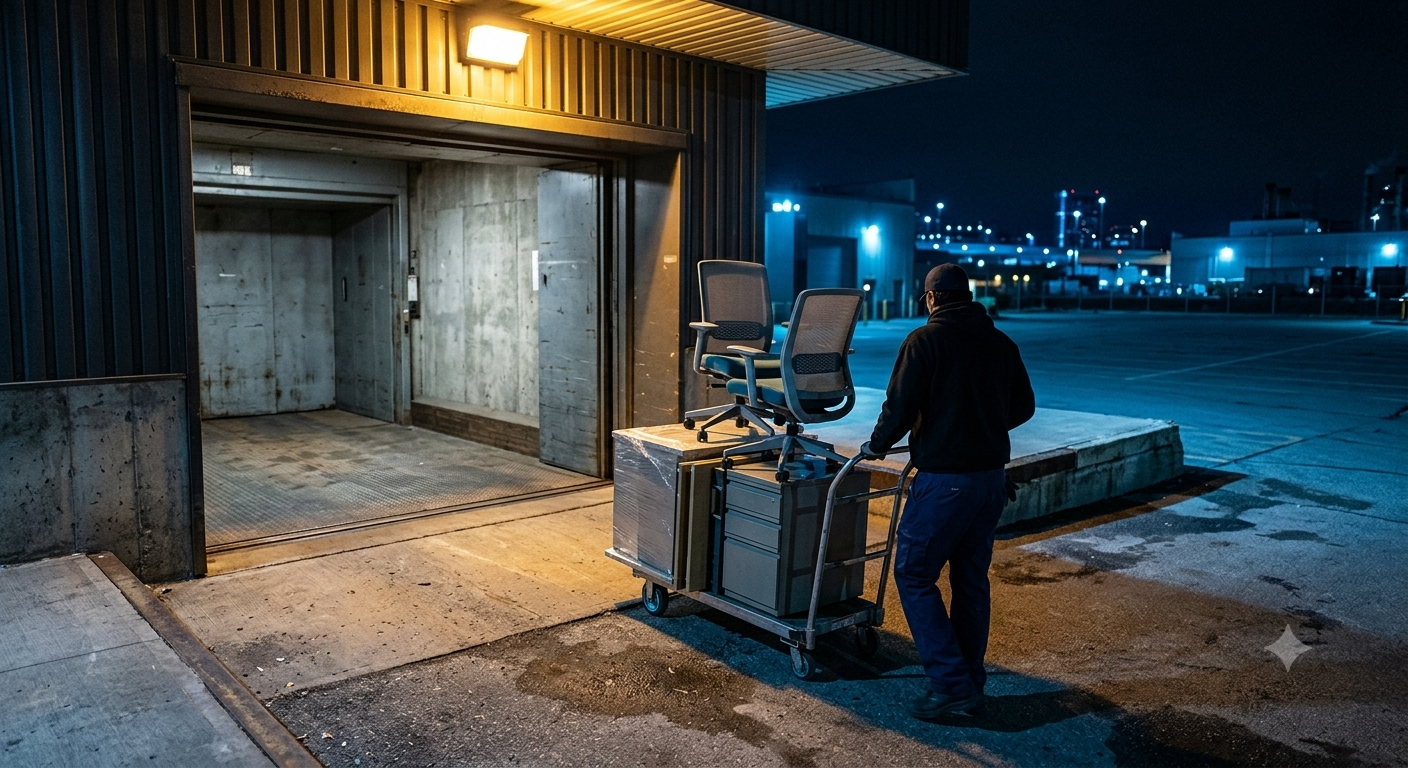
Moving during business hours means moving around your own staff. Moving after hours or over a weekend means the office is empty when the crew arrives and full again, fully functional, when staff walk in Monday morning. That single difference changes access planning, crew scheduling, and what “done” actually means by the time the move is over.
This is what shifts when a move happens outside the standard workday, and where the planning has to start earlier than it would for a daytime move.
Building access becomes the first constraint, not an afterthought
During business hours, the building is already open and staffed. After hours and on weekends, it usually is not, and that changes who needs to be involved before a date is even set.
Security and access coordination. Badge access after hours, security desk staffing, and after-hours entry procedures vary by building and are frequently different from daytime access. This needs confirmation with building management before a cutover date is locked, not discovered on the move date.
Elevator and dock reservations. Freight elevators and loading docks are often shared resources in multi-tenant buildings, and after-hours or weekend use may require separate scheduling, sometimes with different rules than weekday reservations. A dock slot confirmed for a Tuesday afternoon does not automatically confirm for a Saturday morning.
HVAC and building systems. Many commercial buildings run reduced heating, cooling, and lighting outside business hours to save cost. A crew working a full shift in a building running on weekend HVAC settings is a different working environment than the same space on a Tuesday, and it is worth confirming before the crew arrives rather than adjusting on site.
Crew scheduling works differently outside standard hours
A weekend or after-hours cutover is typically a compressed, continuous effort rather than a move spread across a normal workday, because the entire point is finishing before the building returns to normal use. That changes how the crew plans the sequence.
Phasing that would tolerate a pause overnight during a weekday move often gets planned as a single continuous push for a weekend cutover, because a partial move is a much bigger problem Monday morning than a partial move at 5pm on a Tuesday when staff are already gone for the day.
What “done” means for a Monday morning cutover
The bar for a weekend cutover is not “the furniture is in the building.” It is “an employee can sit down at their desk Monday morning and start working,” which is a materially higher bar.
That means workstations set up and functional, not just placed. It means IT and network connections confirmed live where that falls within the move scope, not assumed. And it means walk-through and cleanup completed before staff arrive, so the first thing anyone sees Monday is a working office, not a move in progress.
Where climate-controlled transport and padded packing matter more, not less
Equipment sitting in a truck or staging area for a compressed weekend window still needs the same protection it would need on a weekday move. Padded crates and climate-controlled trucks matter regardless of when the move happens, but a weekend cutover often means equipment is in transit or staged for a longer continuous stretch without the option to pause and reassess mid-week, which is one more reason the packing and transport standard should not be relaxed just because the schedule is compressed.
The tradeoff worth being clear about upfront
An after-hours or weekend cutover avoids disrupting a working day, but it typically means overtime or premium scheduling for the crew, and it compresses the window for catching and fixing problems compared to a move that can spread across normal business hours with staff on hand to answer questions in real time. Neither is automatically the right call. It depends on how much a day of visible disruption actually costs your organization against the premium of moving outside standard hours.
Plan the cutover around Monday morning, not just moving day
The building access, crew sequencing, and readiness bar for a weekend cutover all get set well before the truck arrives. Getting them wrong shows up as an office nobody can use Monday, which is the one outcome an after-hours move is supposed to prevent.
VGS Logistics plans office moves around the schedule that actually works for your operation, including after-hours and weekend cutovers, with move management coordinating building access, crew sequencing, and readiness before the date is set.
Tell us your building’s access rules and your Monday morning deadline, and we will build the cutover plan around both.
Request a quote or call 503.878.5102.